Site updated 5/12/13
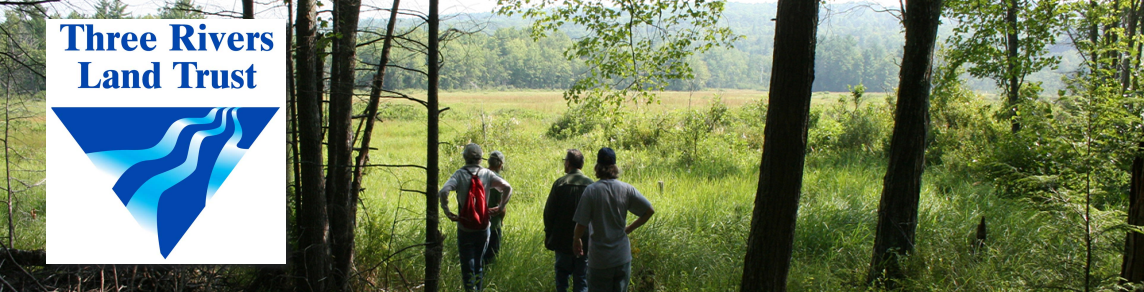
Hobb's Farm Marsh - Summer
Hobb's Farm Marsh - Winter - South Acton Swamp photos by Jean Noon
MISSION STATEMENT:
“To maintain, support and enhance the working landscape of farms and forest and such valued natural resources as lakes, rivers, streams, wetlands, historic sites, scenic places and wildlife habitat, in the inland municipalities of York County, Maine, by acquiring property in fee and conservation easements, and by garnering community support.” (Acton, Alfred, Lebanon, Sanford/Springvale, Shapleigh)
501c(3) status with the IRS: ID# 01-0539771 DLN: 17053024059011 Founded in 2000
Three Rivers Land Trust is a member supported organization dedicated to helping landowners preserve and protect their properties primarily through easements. e-mail us with questions or for membership and /or donation information. We are also eager for volunteers to join us in our work. info@3rlt.org
3RLT News and ANNOUNCEMENTS:
NEXT REGULAR BOARD MEETING MAY 15, 6:45 DOWNSTAIRS AT THE ANDERSON LEARNING CENTER BRADEEN ST. SPRINGVALE.
The Sanford Farmers Market is open in Central Park, Down town Sanford Saturdays 8-12:00 and Wednesdays at Springvale's Rite-Aid 1-5:00
2013 Winter Horizons is available, click here! Subscribe to our eNewsletter
"FOREST WORKS!" - York County Working Forest Protection Project- Has been started! And has a web site! Lee Burnett will be working as our Working Forest Outreach Professional.
Visit the site for some great short videos of frogs, and trees and stuff!
http://www.forestworksme.org/index.html Let us know what you think!
For more information, Please call:
Lee Burnett
207.324.1596
207.206.2106
Tree Frog egg mass:
Below is an excerpt from Vernal Pools of the Forest, a Groundswell of Life, by New England Forestry Foundation volunteer and contributing writer, Professor Scott Shumway.
We hope you enjoy and celebrate the splendor of the woods during the beautiful spring season!
______________________________
Something magical happens in New England forests on the first warm rainy night of spring. Wood frogs and spotted salamanders crawl out of the leaf litter and march toward a vernal pool. They travel not just to any vernal pool, but to the one from which they hatched as a baby. The goal of this migration is to find a mate and regenerate their species. It is a rite of spring for amphibians - and humans - many who gather to witness this annual passage.
Vernal pools are depressions in the ground that contain water for part of the year. Vernal pools dry up, either annually or periodically. Most pools are at their fullest point in the spring, hence the name "vernal" pool. In reality, some flood in the fall and others only dry up every few years, if ever. The important thing is that the pools are free of fish, which if present, would eat the baby amphibians.
Wood frogs and mole salamanders (spotted, blue spotted, Jefferson's, and marbled) mate, lay eggs, and develop from larvae to adults only in vernal pools. Spring peepers, whose "weep weep weep" calls convey the message that spring has finally arrived, will also breed in vernal pools. However, true credit for the start of spring should go to the wood frogs. As soon as they arrive at a vernal pool, the males begin calling loudly to their mates. Their chorusing sounds like a multitude of quacking ducks. Dozens of frogs calling at once produce a deafening cacophony that can be heard far from the pool. In fact, you may wonder why a flock of ducks is quacking in the woods in the middle of the night. (It is best to keep such thoughts to yourself!)
Once born, the baby frogs and salamanders are in a race against time to develop to the point where they can crawl or hop into the woods before they get eaten, suffocate from lack of oxygen, or the pool dries up. The amount of water contained in a pool and how long it holds water is unpredictable and changes from year to year due to variation in precipitation. Some years are more favorable than others.
For roughly 360 days of the year, these animals crawl about in the leaf litter of the forest surrounding their pools and are rarely seen. How far they venture from their pool is hard to determine. One study found spotted salamanders several hundred yards from their pool. Clearly in order for wood frogs and mole salamanders to survive, they must have both vernal pools for breeding and upland forest for when they are not breeding.
Vernal pools are vital for many amphibians to continue their life cycle. New England Forestry Foundation's work in conservation and sustainable forest management help continue the success of these species for many years to come.
________________________________
Scott Shumway is Professor of Biology at Wheaton College in Norton, MA, cofounder of Wheaton's Vernal Pool Research Team, author of the Naturalist's Guide to the Atlantic Seashore, a director of the Westborough Community Land Trust, and volunteer at New England Forestry Foundation. His book is available on www.amazon.com with five star reviews!
Thank You New England Forestry Foundation!
Hunters Please Note: Most of our easements (land protected by 3RLT) are on private land where hunting is by permission only.
Working Forests owned by and with 3RLT easements are harvested using sustainable best management practices.
TRAILS MAPS: "Quiet Places, Hiking and Water Trails of Western York County" ARE AVAILABLE!!! They may be purchased for $3.95 at: Crum's Cycles; Springvale Hardware; Shaw's Hardware; Sanford Springvale Chamber of Commerce; Fall's Agway; Norman Hardware; J & S Grocery & Deli; Springvale Nurseries; Springvale Library; Jeff Daigle Dentist Office; Acton Trading Post;Goodall Library; Giles Family Farm, Alfred; Conant Reality, Alfred; Shapleigh Corner Store; Boonies; Oak Hill Alpacas; Emery Mills Market; Laudholm Farm;Stone Soup Artisans, 228 Main St. Saco; Coastal Maine Kayak, 8 Western Ave. Lower Village, Kennebunk and One Earth Natural Foods, Shapleigh. Please Contact us if you are interested in carrying them in your store or find a store that has run out.
324-3733

